
Artwork Overview
Title, Artist, and Medium
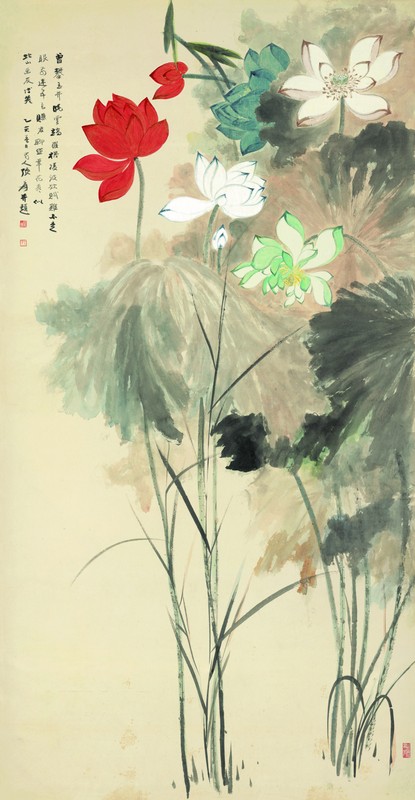
Zhang Daqian (1899–1983), Five-Color Lotus, ink and color on paper, hanging scroll. The composition is vertical, characterized by fluid brushwork and vibrant colors.
Micro-texture and High-Definition Detail
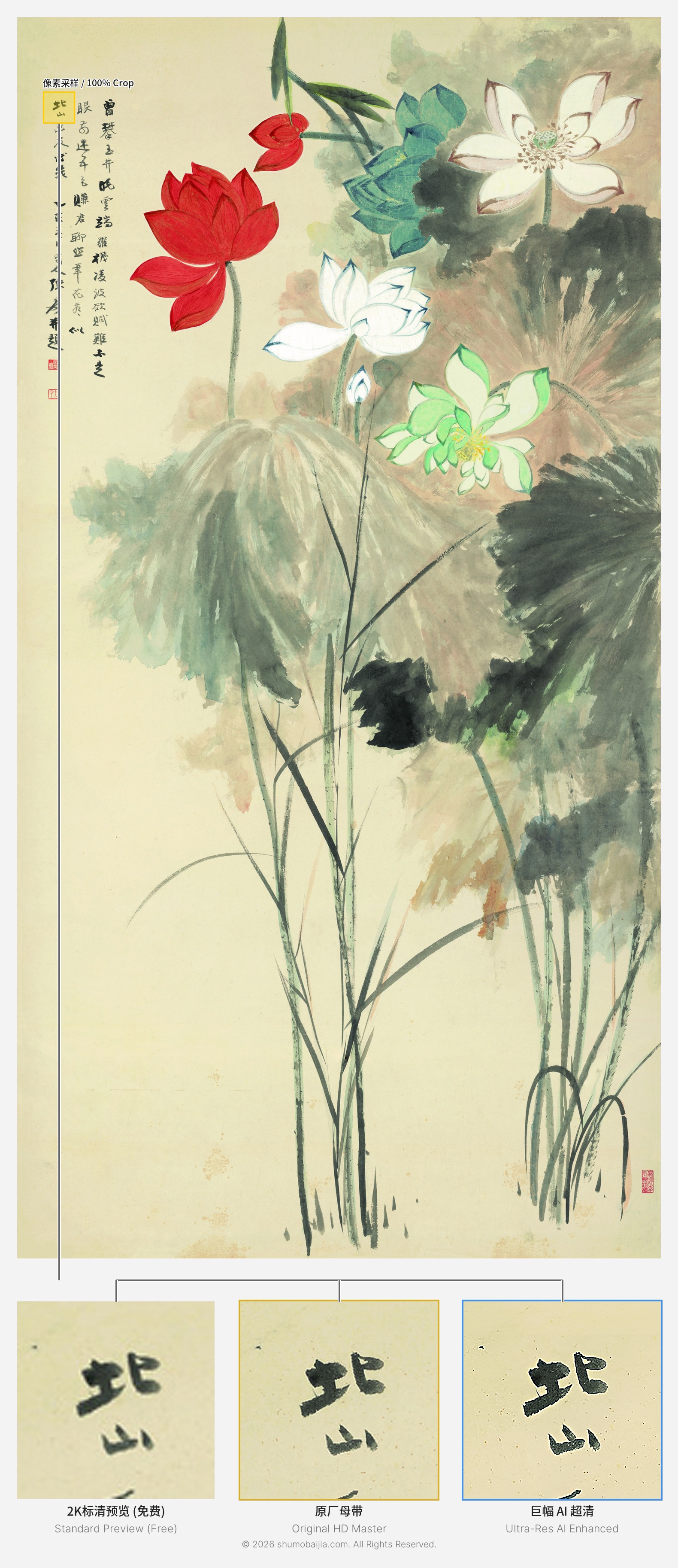
This section displays the artist’s inscription and seals. High-resolution magnification reveals the nuances of brushwork, paper fibers, and the subtle wear on the seals, providing valuable information for connoisseurship.
Context of Creation
This work was painted in the summer of 1945, during Zhang Daqian’s mature period while residing in Chengdu. The artist depicts a lotus pond with a distinctive approach. Lotus leaves are rendered with broad, expressive ink washes, rich in tone and texture, interspersed with light ochre and azurite. The lotus blossoms combine the mogu (boneless) technique with fine outlines. Vermilion red lotuses appear vibrant, white lotuses elegant, and malachite green lotuses unique, creating a harmonious interplay of five colors. The lotus stems, executed with seal script brushwork, are upright and strong, anchoring the composition and conveying the vitality of a summer lotus pond.
Symbolism and Cultural Significance
In traditional Chinese culture, the lotus symbolizes purity and integrity, representing the noble character that rises untainted from the mud. The five-color lotus further suggests blessings and a rich, colorful life. The red, white, and green lotuses, set against the ink-washed leaves, create both strong contrast and unity. This reflects the artist’s observation of nature’s dynamism and the refined aesthetic of literati painting.
Authentication and Provenance
An inscription in running script in the upper left reads: “Once climbed the Jade Pool’s morning peak, Xizi (Lady Xi Shi) applies makeup, autumn approaches. Even if I don’t meet my lover, I should reflect on myself; a hundred years of feelings entrusted to allied gulls. Inscribed by Zhang Daqian Yuan in the summer of yiyou (1945).” Two seals are impressed, one in the lower left and one in the lower right (specific seal impressions, often including “Zhang Yuan zhi yin” and “Daqian Jushi,” are not fully legible in the image).
Display Recommendations
This piece is suitable for a study or living room in a New Chinese, modern minimalist, or Zen-inspired interior. It can be framed in a slender wenge or walnut-colored frame and displayed on an off-white or light grey textured wall. Adjacent placement of a bamboo plant or a miniature dry landscape (kare-sansui) with warm accent lighting can enhance the scholarly and tranquil atmosphere.